
In human anatomy, the mouth is the first portion of the alimentary canal that receives
food and produces saliva.
food and produces saliva.
In addition to its primary role as the beginning of the digestive system, in humans the
mouth also plays a significant role in communication. While primary aspects of the voice
are produced in the throat, the tongue, lips and jaw are also needed to produce the
range of sounds included in human language.
mouth also plays a significant role in communication. While primary aspects of the voice
are produced in the throat, the tongue, lips and jaw are also needed to produce the
range of sounds included in human language.
The mouth consists of two regions, the vestibule and the oral cavity proper. The mouth,
normally moist, is lined with a mucous membrane , and contains the teeth. The lips mark
the transition from mucous membrane to skin, which covers most of the body.
normally moist, is lined with a mucous membrane , and contains the teeth. The lips mark
the transition from mucous membrane to skin, which covers most of the body.
The mouth plays an important role in eating, drinking, breathing and speaking.
Infants are born with a sucking reflex, by which they instinctively know to suck for
nourishment using their lips and jaw. The mouth also helps in chewing and biting food.
Infants are born with a sucking reflex, by which they instinctively know to suck for
nourishment using their lips and jaw. The mouth also helps in chewing and biting food.
Anatomy of the mouth
Lips : – two mobile and muscular structures that form the entrance to the mouth. The
lips mark the transition from skin to moist mucous membrane.
lips mark the transition from skin to moist mucous membrane.
The Vestibule : the space between the soft tissue (lips and cheeks), and the teeth and
gums. The vestibule is kept moist by secretions from the parotid salivary glands, which
are located in front of the ears and behind the angle of the jaw.
gums. The vestibule is kept moist by secretions from the parotid salivary glands, which
are located in front of the ears and behind the angle of the jaw.
Mouth Cavity : – the mouth cavity is bounded by several structures. The alveolar arches
(bony structures that contain the teeth) surround the mouth cavity at the front and on
the sides – overhead are the hard and soft palates and below is the tongue. The mouth
cavity is kept moist by secretions from the submaxillary and sublingual salivary glands
located in the floor of the mouth beneath the tongue.
(bony structures that contain the teeth) surround the mouth cavity at the front and on
the sides – overhead are the hard and soft palates and below is the tongue. The mouth
cavity is kept moist by secretions from the submaxillary and sublingual salivary glands
located in the floor of the mouth beneath the tongue.
Gums/Gingiva : – are made up of the fibrous and dense tissue that lines the alveolar
arches and hugs the teeth.
arches and hugs the teeth.
Teeth : – a person has two sets of teeth over the course of a lifetime. The average child
has their full set of 20 primary (or milk or baby) teeth by the age of three years. The
primary teeth start to fall out between the ages of about six and seven years, and are
gradually replaced by permanent (or secondary or adult) teeth. By about 21 years, the
average person has 32 permanent teeth – 16 in the upper jaw and 16 in the bottom jaw.
has their full set of 20 primary (or milk or baby) teeth by the age of three years. The
primary teeth start to fall out between the ages of about six and seven years, and are
gradually replaced by permanent (or secondary or adult) teeth. By about 21 years, the
average person has 32 permanent teeth – 16 in the upper jaw and 16 in the bottom jaw.
Palate : – consists of the hard and soft palates. The hard palate is the bony roof of the
mouth. The soft palate is a fold of membrane that hangs between the mouth cavity and
the back of the throat. The little dangling bit you can see when you stick out your tongue
and say ‘ah’ is called the uvula.
mouth. The soft palate is a fold of membrane that hangs between the mouth cavity and
the back of the throat. The little dangling bit you can see when you stick out your tongue
and say ‘ah’ is called the uvula.
Tongue : – the tongue is made up almost entirely of muscle fibres. It is divided into an
oral portion (tip, blade, front, centre and back) and a pharyngeal (throat) section. The
tongue helps us to taste, speak and swallow.
oral portion (tip, blade, front, centre and back) and a pharyngeal (throat) section. The
tongue helps us to taste, speak and swallow.
Minor salivary glands : – make the clear fluid (saliva) that keeps the mouth moist and
contains enzymes to break down food. These glands are found in various locations around
the mouth, including the inner cheeks.
contains enzymes to break down food. These glands are found in various locations around
the mouth, including the inner cheeks.
Problems of the mouth
Cold sores
Canker sores - painful sores in the mouth, caused by bacteria or viruses
Cold sores
Canker sores - painful sores in the mouth, caused by bacteria or viruses
Thrush - a yeast infection that causes white patches in your mouth
Dry mouth - lack of enough saliva, caused by some medicine.
Tooth problems.
Halitosis (bad breath)

enough money to fund his education. His siblings took to bad ways. They were lazy,
thieved food and money to keep their body and soul together. This left a bad taste in
Tom's mouth. Undeterred , he continued with his studies and earned a college degree.
Readers , do you visit your dentist regularly? Do you prefer to have mouth refreshner
(Mukhvas) after food?
(Information courtesy Google)
(Google pics)
I am participating in the A to Z Challenge.
A to Z Challenge - Day 10. Kidneys - Parts of the body
A to Z Challenge - Day 11. Lungs - Parts of the body
Dry mouth - lack of enough saliva, caused by some medicine.
Tooth problems.
Halitosis (bad breath)
Care of the mouth
The mouth may become dry due to high fever, vomiting or lack of fluid intake. Mouth
care helps to stimulate the flow of saliva which prevents it from becoming sore. Keeping
the person mouth clean, moist and free from infection is important in the prevention of
dental problems. Cleaning the teeth regularly helps to remove plaque and debris which
cause tooth decay and bad breath. Good oral hygiene may also help to increase
appetite.
Cleaning or rinsing the mouth after meals should be done.
Breathe through the nose. Breathing through the mouth makes the mouth dry.
Brush teeth every morning, after meals and at bedtime. Floss regularly.
If a person wears dentures, he/she should rinse mouth and dentures after every meal.
Eat a well-balanced , low sugar diet. Chew on raw salads. It encourages saliva formation.
Indian Mouth freshener
care helps to stimulate the flow of saliva which prevents it from becoming sore. Keeping
the person mouth clean, moist and free from infection is important in the prevention of
dental problems. Cleaning the teeth regularly helps to remove plaque and debris which
cause tooth decay and bad breath. Good oral hygiene may also help to increase
appetite.
Cleaning or rinsing the mouth after meals should be done.
Breathe through the nose. Breathing through the mouth makes the mouth dry.
Brush teeth every morning, after meals and at bedtime. Floss regularly.
If a person wears dentures, he/she should rinse mouth and dentures after every meal.
Eat a well-balanced , low sugar diet. Chew on raw salads. It encourages saliva formation.
Indian Mouth freshener
Mukhwas is a colorful Indian after-meal mouth freshener or digestive aid
It can be made of various seeds and nuts, but often found with fennel seeds, anise
seeds, coconut, and sesame seeds. They are sweet in flavor and highly aromatic . Plain
water is drunk after chewing and consuming the fennel seeds.
Dried Amla (Indian goosebery) is also chewed after food as mouth freshener. It is
available in powdered form too.
Dried Amla
The word is an amalgamation of mukh meaning mouth and vas meaning smell. My
grandmother used to have betel-nut leaf and pieces of betelnut after food. I sometimes
chew on fennel seeds.
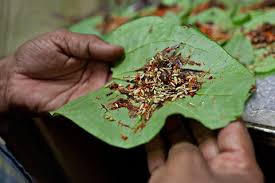

The Indian Paan is had on auspicious occasions like marriage or festivals. It is usually
eaten after a hearty heavy indian traditional meal.
grandmother used to have betel-nut leaf and pieces of betelnut after food. I sometimes
chew on fennel seeds.
The Indian Paan is had on auspicious occasions like marriage or festivals. It is usually
eaten after a hearty heavy indian traditional meal.
The dreaded Big C
Cancer of the mouth can grow in any part of the mouth or throat. A dental checkup is a
good time for your dentist to look for signs of oral cancer. Treatment works best before
the disease spreads.
Even if one have lost all your natural teeth, one should still see the dentist for regular
oral cancer exams.
Cancer of the mouth can grow in any part of the mouth or throat. A dental checkup is a
good time for your dentist to look for signs of oral cancer. Treatment works best before
the disease spreads.
Even if one have lost all your natural teeth, one should still see the dentist for regular
oral cancer exams.
Avoid tabacco and its products. Abstain from cigarettes, snuff , pipes or cigars.
Drink alcohol in moderation.
Trivia
Drink alcohol in moderation.
Trivia
enough money to fund his education. His siblings took to bad ways. They were lazy,
thieved food and money to keep their body and soul together. This left a bad taste in
Tom's mouth. Undeterred , he continued with his studies and earned a college degree.
Readers , do you visit your dentist regularly? Do you prefer to have mouth refreshner
(Mukhvas) after food?
(Information courtesy Google)
(Google pics)
I am participating in the A to Z Challenge.
A to Z Challenge - Day 1. Arms : Parts of the body
A to Z Challenge - Day 2. breasts : Parts of the body
A to Z Challenge - Day 3.Chin & Cheeks : Parts of the body
A to Z Challenge - Day 4. Dimples : Parts of the body
A to Z Challenge - Day 5. Eye : Parts of the body.
A to Z Challenge - Day 6. Feet: Parts of the body
A to Z Challenge - Day 7 . Gums/Gingiva
A to Z Challenge - Day 8. Hair : Parts of the body
A to Z Challenge -Day 9. Intestine : Parts of the bodyA to Z Challenge - Day 10. Kidneys - Parts of the body
A to Z Challenge - Day 11. Lungs - Parts of the body

